
Lithium Ion (LION)/ Lithium Polymer (LIPO) Battery Safety & Instructions
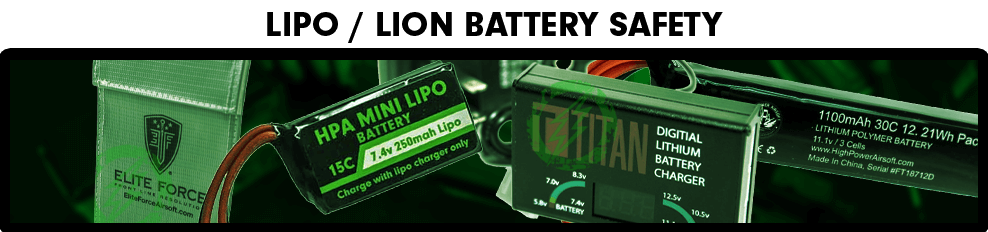
Safe LiPo Battery Handling and Charging Practices
Objective
To educate on the safe handling and charging of Lithium Polymer (LiPo) and Lithium-Ion (Li-Ion) batteries, thereby minimizing the risk of fire, injury, and property damage.
I. Introduction to LiPo/Li-Ion Batteries and Safety Imperative
LiPo and Li-Ion batteries are powerful energy sources widely used in airsoft due to their high power output and lightweight design. However, their unique chemistry demands strict adherence to safety protocols, especially during charging and handling. Failing to follow these guidelines can lead to severe consequences, including fire, explosion, and serious injury. Your vigilance is critical to ensuring a safe environment.
II. Core Safety Cautions for LiPo/Li-Ion Battery Charging and Handling
1. Use the Right Charger (LiPo/Li-Ion Specific!)
- Rule: Always use a charger specifically designed for Lithium Polymer (LiPo) or Lithium-Ion (Li-Ion) batteries.
- Why: LiPo/Li-Ion chargers, particularly "balance chargers," are engineered to precisely monitor and regulate the voltage of each individual cell within the battery pack. This prevents overcharging of any single cell, which is a primary cause of battery failure and fire.
- Prohibition: Never use chargers designed for other battery chemistries like NiCd or NiMH. These chargers lack the necessary safety features for lithium-based batteries and will lead to dangerous overcharging.
- Action: Verify the charger is clearly labeled "LiPo" or "Li-Ion" and is capable of balancing individual cells.
- Suggested product: Titan Power Digital Lipo Charger | Lion Battery Charger
2. Never Charge Unattended
- Rule: LiPo/Li-Ion batteries must not be left unattended during charging.
- Why: While rare, battery failures can occur suddenly and without warning. Immediate action is critical. You must be present to react if there are any signs of swelling, smoke, or fire.
- Action: Actively monitor the charging process. If you need to leave the charging area, even briefly, disconnect the battery from the charger.
3. Charge in a Fireproof Container and on a Non-Flammable Surface
- Rule: Always contain the battery within a fireproof enclosure and place it on a non-flammable surface during charging.
- Why: In the event of a thermal runaway (fire), the container will help contain the flames and prevent them from spreading. A non-flammable surface ensures that heat or fire does not ignite the ground below.
- Action: Utilize a designated LiPo-safe charging bag or a sturdy metal ammo box (modified with a ventilation hole) as the primary containment.
- Charge on surfaces such as concrete, ceramic tile, stone, or a dedicated fireproof mat.
- Keep the charging area clear of any combustible materials (e.g., paper, cardboard, cleaning rags, chemicals).
- Suggested product: Titan Power Lithium Charging Safety Bag | Lipo Sack
4. Check Battery Condition Before Charging
- Rule: Visually inspect every LiPo/Li-Ion battery for any signs of damage before initiating the charging process.
- Why: Damaged batteries are inherently unstable and pose an extreme fire risk. Attempting to charge a compromised battery can lead to immediate failure.
- Action: Examine the battery for any swelling or "puffing" (the battery appearing bloated or ballooned).
- Check for punctures, cuts, tears in the wrapper, exposed wires, or bent/cracked terminals.
- Never charge a damaged or swollen battery. Segregate it immediately and follow proper disposal procedures (see Section III).
5. Understand Voltage and Cell Count
- Rule: Accurately identify the voltage and cell count of the LiPo/Li-Ion battery and set the charger accordingly.
- Why: Lithium batteries come in various configurations (e.g., 7.4V 2-cell, 11.1V 3-cell). Selecting incorrect settings can lead to severe overcharging or undercharging, damaging the battery and creating a fire hazard.
- Action: Read the battery label to confirm its voltage (e.g., 7.4V, 11.1V) and cell count (e.g., 2S, 3S).
- Ensure the charger settings precisely match the battery's specifications.
- Understand that each LiPo/Li-Ion cell has a nominal voltage of 3.7V. A 2-cell (2S) battery is 7.4V; a 3-cell (3S) battery is 11.1V.
- Do not attempt to charge a deeply discharged battery (below 3.3V per cell, e.g., a 2-cell pack below 6.6V, a 3-cell pack below 9.9V). These batteries may be permanently damaged and unsafe to charge.
6. Don't Overcharge (and Avoid Over-Discharging)
- Rule: Prevent overcharging
- Why: Overcharging a LiPo/Li-Ion battery beyond its maximum safe voltage (4.2V per cell) causes irreversible damage, internal stress, and a high risk of thermal runaway. While over-discharging (below ~3.0V per cell under load) doesn't cause immediate fire risk during discharge, it permanently damages the battery, making it unsafe to recharge and significantly shortening its lifespan.
- Action: Always use a proper LiPo/Li-Ion balance charger that automatically stops charging when the battery reaches its full safe voltage (4.2V per cell).
- Never attempt to "force charge" a battery beyond its indicated capacity.
- Use LiPo alarms or MOSFETs with low voltage cut-offs in their airsoft guns to prevent over-discharging.
7. Proper Current (C-Rating)
- Rule: Set the charging current appropriately, generally not exceeding 1C unless specified by the battery manufacturer.
- Why: Charging too quickly (at too high a current) can cause excessive heat buildup and internal stress, leading to battery damage and potential fire. "1C" refers to a charging current equal to the battery's capacity (e.g., a 2000mAh battery charged at 2.0 Amps (2000mA) is 1C).
- Action: Locate the battery's capacity in mAh (milliampere-hours).
- Set the charger's current output to match the 1C rate (e.g., for a 1500mAh battery, set current to 1.5A).
- Only exceed 1C if the battery manufacturer explicitly states it is safe for faster charging (e.g., "2C charge rate").
8. Allow to Cool Down
- Rule: Allow LiPo/Li-Ion batteries to cool to ambient temperature before charging if they have just been used.
- Why: A hot battery is already under thermal stress. Charging it while hot can exacerbate this stress, accelerate degradation, and increase the risk of overheating.
- Action: After a battery has been used in an airsoft gun, allow it to rest and cool down completely (to room temperature) before connecting it to a charger.
9. Keep Away from Children and Pets
- Rule: Store and charge LiPo/Li-Ion batteries out of reach of children and pets.
- Why: Children and pets may not understand the dangers associated with these batteries and could inadvertently damage them or place themselves in harm's way.
- Action: Always place charging setups and stored batteries in secure locations inaccessible to minors and animals.
10. Proper Storage
- Rule: Store LiPo/Li-Ion batteries correctly when not in use, especially for extended periods.
- Why: Improper storage can degrade battery performance, shorten its lifespan, and increase safety risks.
- Action: Store batteries in a cool, dry place, ideally between 40-80°F (4-27°C).
- Avoid direct sunlight, extreme heat sources, or freezing temperatures.
- For extended storage (more than a few days), discharge or charge the battery to a "storage voltage" of approximately 3.8V per cell. This is a common feature on most quality LiPo chargers. Never store batteries fully charged or completely depleted.
III. Emergency Procedures: In Case of a Problem
- Immediate Disconnection: If you observe any swelling, smoke, unusual odors, or fire from a charging battery, immediately and safely disconnect it from the charger.
- Safe Relocation: Carefully move the battery to a safe, open, non-flammable area, preferably outdoors on a concrete or paved surface, far away from any combustible materials.
- Observation: Observe the battery from a safe distance.
- Extinguishment: Do NOT use water to extinguish a LiPo/Li-Ion fire. Water can react with lithium and worsen the situation.
- Use a chemical fire extinguisher (Class D or suitable for electrical fires) or smother the battery with a large quantity of sand.
- Ventilation: If a fire occurs indoors, ensure proper ventilation of the area once the fire is safely extinguished.