
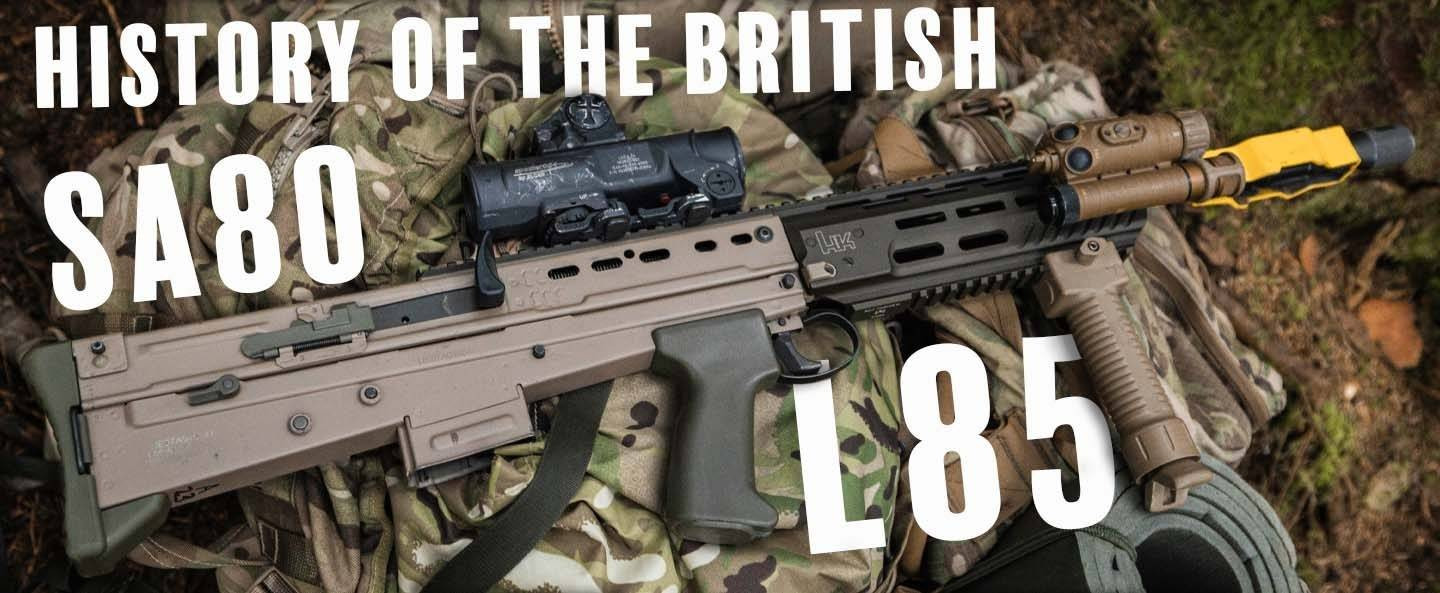
The Classic British Bullpup - L85 / SA80
If you’ve ever looked at the L85 and thought, “That looks weirdly futuristic but weirdly out of place, like a hastily put together option…” you wouldn’t be alone. This rifle has had a long, messy, and surprisingly political journey—from its awkward early prototypes to becoming the sharp, modern bullpup used by the British Army today.
But here’s the kicker: the L85A3 didn’t start out as a reliable weapon. In fact, the original version (the L85A1) was so frustratingly flawed that British troops literally hated it. Fast-forward to now, and thanks to some SERIOUS engineering upgrades and a makeover by Heckler & Koch, the L85A3 is finally being taken seriously.
In this post, we’re diving into the wild history of the L85 platform—from the very first bullpup concepts of the early 1900s, to Cold War politics, to the high-tech rifle you see in today's loadouts. Whether you’re an airsoft nerd, a history buff, or just curious why the British military stuck with a rifle that almost failed from the start—this is for you.
For full transparency; I did NOT use Wikipedia for any information. I used multiple books, dozens of websites from Britain and other authors, soldier biographies, magazines from 1950 to 2020, essentially covered the service life leading to the conception of a military bullpup with the Thorneycroft Pattern 1 Rifle all the way up to the current H&K L85A3. There is plenty that I did not talk about since this blog would've turned into a short book.
This blog is also the culmination of weeks and hundreds of hours of researching the history of the L85, what led to its adoption and what how it performed. Despite its long service there is still not alot of clear and obvious sources that paint a direct line of variants. For example; when looking at the .22 cal Cadet and training conversion I am Googling the 'L41A1 Conversion' and there is a total of 3 Google pages, Yahoo gives me photos of the magazines and diagram of the conversion bolt, and DuckDuckGo is similar to Yahoo. It was not until I started collecting books that I found a clear photo of the .22 cal conversion that I was curious about.
This is not to say that I am now an expert, I am trying hard to be thorough. Which is also frustrating when authors of texts are seemingly withholding additional information that I was interested and only just recently have released content around those rifles. Which I will dicuss later in this writing.


Early Bullpup Experiments (1901–1950s)
The L85’s story actually starts over 120 years ago, where the novelty of a bullpup design begins to creep into rifles for military application. In 1901, a small British team filed a patent for a bolt-action bullpup rifle—the Thorneycroft Pattern 1. It was a bold idea: move the action behind the trigger to shorten the gun without cutting down the barrel. But at the time, it was too weird, too ahead of its time, and shelved despite several testers remarking the overly positive effects of the new design.
To not delve too deep into weapons that did not have a direct influence on the L85 I still want to share some information that I have uncovered; James Thorneycroft was the older brother of Andrew Thorneycroft, Andrew was an Officer (since he will go through several promotions in his career I did not want to glance over his credits) of the Thorneycroft Mounted Infantry Regiment (TMI) who have made several contributions in the Second Boer War of 1899-1902 and that short conflict left the Colonial British Military with many lessons to learn and take away. When reflecting on how the doctrine and tactics had transformed it was no doubt that the Second Boer War had an influence on future conflicts. Small Arms, Clothing, Gear, Officer Responsabilities, and small effects that webbed backwards from the frontline. An officer from the TMI by the name of Moubray Farquhar is believed to be the designer of the first variant of the Thorneycroft Pattern of rifles, James Thorneycroft being the investor of the project. I believe that the Thorneycroft Rifle, unlike the Godsal Rifle, was made out of necessity rather than luxury. In reading about the doctorine of how the TMI would move and react to the Boer adversaries in South Africa I beleive that Moubray wanted a rifle that would have a positive effect on horse mounted soldiers. After hearing how close-knit the TMI regiment was I can empathize with the feeling of wanting to do everything for his men still in conflict.

While doctrine is strict and unwavering of Mounted Infantry Soldiers dismounting before returning fire and maneuvering on an enemy force, I cannot help but imagine that the immediate response to Boer combatants (who wore natural colored clothing, were expert hunters and marksmen, would position themselves behind cover and in hides, would conduct guerilla warfare, and had the 'new' Mauser rifles) would be to immediately return fire and pull back a safe distance to establish a fighting position. If I was a TMI soldier riding on horseback ahead of the regiment and was jumped by a young Boer man wanting to prove himself, I know that I would not jump off the horse to take a shot and then get back on my horse. I'd be firing from the back of my horse so I can get out of there ASAP!
If that would be the type of fighting I would be getting into then it would make sense that the unit that was dealing with alot of horseback transportation and maneuvering to support other forces would need something better balanced that did not compromise muzzle velocity or accuracy to match the capabilities of the Boer forces. All that to say; for the time and theorized application I think the Thorneycroft Rifle was a step in the right direction for mobile forces, but I do not think that if rapidly adopted would have an incredible effect on the outcome of conflicts.
Winston Churchill would serve in the Boer War, as did Arthur Conan Doyle (Sherlock Holmes Author) and Lord Baden-Powell (Founder of the Boy Scouts) and many more influential figures.
The purpose and intention was to shift the operation and weight of the rifle backwards towards the shooter, on the original patent its stated below;
“This invention, which relates to rifles and other small-arms… the entire length of the weapon is about the same length as a carbine, which is more suitable for use by mounted troops than the longer weapon and has the full range of the latter.”

In the early days of firearm design you have to take a step back in appreciation, consider that machining and technology is not where its at today. Knowing that cars were barely even a thing in England around this time, it's incredible that firearms have progressed as far and as quickly as they did. Men working long hours in factories around mills and lathes, making all of these firearms by hand. Specifications up to a fraction of a millimeter.


USA Ruins the Party (1950's)
So what happened next? Politics is what happened.

(as a note to the image; this is a photo from 'Soldier' Magazine for the British Army, November 4th 1985 showing Sergeant Gary Gavin with the brand new SA80/L85A1)
In addition, there was a few examples of other rifles being transformed into a bullpup configuration, the initial influence of the EM-2 in the early trials were seen favorable enough for firearm designers to make semi-functioning, if not fully functionable, rifles to service as a test bed for the possability of this unorthodox configuration. Such examples are John Garands T-31 rifle, FN .280 Auto 'Short Model', Soviet Experimental 7.62 bullpup rifles, the Famas and Steyr AUG experimented in the late 60's.
Image Bottom Left is a bullpupped Garand and Bottom Right is a bullpupped FN FAL for your viewing pleasure.


Churchill had previously fired the EM-2 and the M14 prototype (T25) when both rifles were being presented as a comparison (along with an FAL prototype) for NATO standarized service weapon selection. 77 year old Churchill enjoyed the EM-2 (shooting it shouldered and from the hip for extended bursts at various distances) and detested the M14 prototype, shooting only 11 rounds before putting it down and remarking that he did not want to fire it any longer "I do not wish to fire the damn thing any more." Churchill, in his wisdom, knew that the U.S. was not going to accept the EM-2 but he thought perhaps he could get the U.S. to consider the FAL, and the U.S. was able to get a license to produce the FAL in the U.S. for weapon trials. The U.S. arrogantly stuck with the .308 round and continued to develop the T25 into the iconic M14. Eventually Britain and several other European countries adopted the FAL as the service weapon. Perhaps adopting the FAL to spite the M14 and the U.S.

The SA80 and the Mess of the L85A1 (1970s–1980s)

Enfield didn’t quit. And in likeness of the U.S., would begin experimenting with their own wave of new ammunition. In 1969, they tried again—this time with their own intermediate round: the 4.85x49mm. The prototypes from this era became known as the XL- series and would spend over a decade testing the X.L. series of rifles.
As no doubt some of you are asking; "Why is the name of the rifle changing from L85 to SA80?" The term 'SA80' comes from the name of the program "Small Arms of the 80's" when the British Military was expecting the SLR service weapon would be ending its service life and would be replaced by a new rifle. They did not have the name L85 yet, but the 'L85' name would be interchanged with 'SA80' throughout the years.
The L86A1 would be nicknamed 'The Engager' but suffered from several of the same issues as the L85 individual weapon. Jumping ahead in time the L86 would only get an -A2 upgrade, it would not see an -A3 variant and has been phased out for other preferred rifles. Other rifles that carried higher capacity for extended fire-fights, or 'marksman' rifles that are more accurate at longer distances.
As an additional note; the top right image is an -A2 variant of the L85 that you can tell from the charging handle. However this soldier was originally issued an -A1 since there is tape over the vent holes of the rifle body and gas block, assumedly to keep as much dirt out as possible. There is also a container of oil readily available for some quick maintenance in the desert. The bottom right image is an L86A1 variant from the charging handle. Fun fact as well there is the large long brace under the barrel to support the bipod and not mess with barrel harmonics while the rifle is being fired.


British Soldiers would adopt a ‘Suicide Stance’ where a soldier would grip the rifle right handed, shift the rifle to their left shoulder without changing grip, and then transition the left hand to grasp the buttpad of the rifle. Pushing the rifle slightly forward and holding the eyeline as stable as possible. Keeping their face away from the reciprocating charging handle. Not great, but thats what they did.
As a small little Easter Egg there is a photo that I found of a soldier who was issues one of the rare left handed L85-A1 rifles. The gas mask is also a classic 90's look as well with all the potential gas attacks.


The Redemption Arc: L85A2 and A3
During this time there would also be a short barreled variant called the L22 (despite the name it still fired the NATO 5.56 round) that featured a 15 inch barrel and is most often seen with tank and helicopter crews that need something incredibly tight and short. The advantage of this rifle is that the overall length is 25 inches, and still features a barrel that is considered long enough to burn powder for fast muzzle velocity and retain accuracy and consistency at great distances.
-Flight Lieutenant Ian Caesar (RAF Regiment)


From the initial 4.85mm EWS to the SA80-A2 variant Great Britain is over 30 years investment into that service weapon, and have spent even more time with the EM-2 and feasibility studies (going even further back to 1940s) to attempt to prove that an unorthodox rifles system is the step in the right direction for a modern military force. In the case of the SA80 series of rifles, not considering all of the years of prototype costs, there is the initial cost of the SA80-A1rifle, the cost of in-service modifications to fix the initial issues of the -A1’s, then you have the -A2 prototype and upgrades, and even then theres studies on even more upgrades or updates to the -A2 models in the later 2000’s that led to the Daniel Defense era. The -A2 rifles will be upgraded again into the -A3 rifle, further investing the British into their service weapons. So now, a single rifle for the British government costs thousands of dollars, making the justification to adopt a new weapon system even less of an option.
In the upgrade program there was a process where the dovetail optic mount under the carry handle/iron sight was given picatinny adapters to fit modern optics. In the top left image is an optic riser on the dovetail, and the bottom left is a GL (grenade launcher) variant that has a picatinny adapter attached and either locked or welded into place.
This is also the only time that I had heard of ANYONE using the Magpul P-mag with the included cover. British Service members were very careful to keep the covers on their magazines to keep the internals as clean and dirt-free as possible. Knowledge is power.


This version features a new flat-top upper receiver with full-length rails, modular handguard system, weight reductions, better balance, a new Cerakote finish, and optics compatibility that fits the modern battlefield. It’s now a platform that soldiers trust, and while still heavy, it finally matches the performance of other NATO current service rifles. It also was not without its own needs for upgrades; the first version of the handguard was called HKey (because of the keymod looking attachment points that you see on the image in the right) however a new version with Mlok has been available in 2020 and is now the standard version for the -A3 handguard.
HKey was an H&K attachment method before going to the current and more preferred M-lok attachment. I would like to mention that USSOCOM and CRANE did independent testing on the strength and durability of Keymod versus Mlok using 'commercial-off-the-shelf' rail systems for direct comparisons. M-lok was shown as having the overall best success but did suffer as well under extreme stresses.
Not to point out or suggest that Keymod shouldn't be used, more of a comment that could have led to the utilization of M-lok over HKey.


While not confirmed, the favored replacement options are all a standard rifle configuration, it is not believed that they are going to continue using a bullpup rifle.
Throughout all of this there are still countries who utilize the L85 in a degree of capacity, as well as different groups within different conflicts. It has been fascinating seeing the rifle within different hands, and overall within recent years has been seen in a more positive light. As the saying goes, 'Sometimes no news is good news'.


The Unicorn: Electric Individual Weapon (EIW97)
What the program did was replace a mechical firing pin and replace it with an electronic one so that when loading bullets with special primers that would contact the electronic firing pin and that would initiate the firing process. Everything else on the rifle worked the exact same and nothing else would need to be changed or adjusted. With the incorporation of these electronics is gave engineers a better idea of rifle performance and how the soldier reacts naturally to the rifles performance. The entire system operated similar to early versions of the GATE electronics, plug your rifle in and view the stats and make changes and alterations to the firing modes.
In the case of soldier use the team was looking at how well users would perform with different rates of fire, burst modes, and hit probability with different sized soldiers at different distances. They also evaluated the effectiveness of how adversaries would potentially react to near misses. How the bursts modes and fire rates would have a psychological effect on the battlefield.


For example; in a British Section you will have a Section Commander with 2 fire-teams. The Section Commander has control of one fire-team and a Second-in-Command will have the other fire-team. The fire-teams will have a mix of Marksmen, Machine Gunner, Grenadiers, and Rifleman. The Section Commander will have buttons that will allow him to radio communicate with command, sister units, and the squad. Everyone else in the Section may have a button to communicate with the squad. (some of you may already see an issue with that, especially since those permissions would need to programmed into the rifle with a proprietary software. If your Section Commander goes down and his equipment is damaged, how will he communicate with command and sister units?) The buttons can also program and adjust fire modes and rates of fire. From an open field engagement to a city situation you may want to go from a 2 round slow burst to a rapid full auto that can all get programed via a couple of button presses.
For rifleman application there was discussion of one button press being used to change the electronic trigger, its a microswitch as a reminder, to fire the grenade launcher. Saving on weight and length of needing a trigger mechanism for the launcher. There were also electronics to identify if a chamber was loaded and how many rounds remained in the magazine.
You have also noticed the massive optic that sits on the rifle, which was a massive combination of uses that no doubt can be considerably shrunk in profile with todays equipment. It would work as a thermal, night, magnified optic for soldiers, as well as projecting the view through the optic that would be displayed onto the soldiers digital visor that is attached to the helmet. Presumably to shoot over or around cover, however even just holding an airsoft replica around a door frame was really awkward for hand placement. One discussed feature that was explored was syncing a soldiers rifle to a remote launcher/machine gun that could be controlled via moving the soldiers rifle and firing the remote system via a trigger pull. These were being built and experimented with in the late 90's!
The electronics were not only to get the rifle to fire, they were also built into the back of the rifle. On a soldiers visor display they could identify via a digital HUD where soldiers are positioned via GPS in the rifles. Certain top-down modes could display where each rifle is pointing and potentially set the rifles to not shoot if pointing in a specific direction. Whether it be at another soldier, or a target area with civilians, religious buildings, or Embassy. Which I know that last part is going to get some disagreement.
While this may seem very cool for those who are interested in tech, this can also potentially lead to alot of oversight from commanders. Its also going to get muddier when tech goes down. Murphy's Law is a force not to be messed with. But from a tech perspective, of being able to view the battlefield in real time, identify who is who, what mode their service rifle is in, identify if they are actively shooting, and how much they have fired up to that point is not something that should be shared with any commanding officer. Which in my opinion there is already alot of grief about micromanaging commanders from several countries militaries, lets not give them another reason to abuse the guys on the ground.


That was not the only thing that they were working on, the small glasses would've flipped down to display information and data that may or may not have been critical. But we also know that over time from the early 2000's there was a bunch of technology and systems that made the setup smaller, lighter, and be able to have more information at their disposal to make better decisions for the situation. And the intention of the FIST Program to incorporate that technology and evaluate how a soldier reacts.
With the electronic firing pin the rifle was also equipped with a simulator package, where instead of firing blanks it would have a rod that would slid down the barrel and make a positive connection with the firing pin. When the trigger was pulled the electrical pulse would travel up the rod where an IR bulb would 'Shoot' outward for force-on-force training or it could project onto a screen like the Smokeless Range or Milo Range. Using it during your nephews Laser Tag game would be really cool too.

SA80 in the World
There are also steps to producing SA80 clones in the United States, something that was otherwise impossible with British firearm manufacturers. They had viewed the rifle as a British exclusive and keeping it in country for military usage. The rather aged rifle has begun to grow wings into something that can be used in a modern application.


The rifle that once embarrassed an army has been reborn, with a relatively quiet service right now. There has been little gripe on the current version of the rifle, if there are any issues it is kept downlow and away from medias ears. The only views on the current L85’s is in comparison of other service rifles when in joint training opportunities, where the L85 is heavier and the ergonomics are different than any other rifles. A service history of 40 years already, and a rather quick and brief overview of its evolution through its service.
When viewed as a single snapshot, the L85 seems like an odd outlier among NATO service rifles. But when viewed across more than a century of British small-arms development, it makes sense. From Thorneycroft’s early bullpup patents to the EM-2’s abrupt cancellation, Britain consistently pursued compact, forward-thinking rifle designs—often at odds with alliance politics and industrial realities. The SA80 program represents the culmination of that philosophy, for better and worse. The L85A3 may soon give way to a new generation of rifles, but its legacy is secure: a weapon that encapsulates ambition, failure, perseverance, and eventual competence in equal measure.
Thank you for joining me in the autistic eclectic collection of information that I had acquired through my learning of this rifle. All thanks to picking up my own airsoft rifle from G&G, and spcifically the L85A3 variant, you can watch that video on our YouTube channel and follow our other socials!