
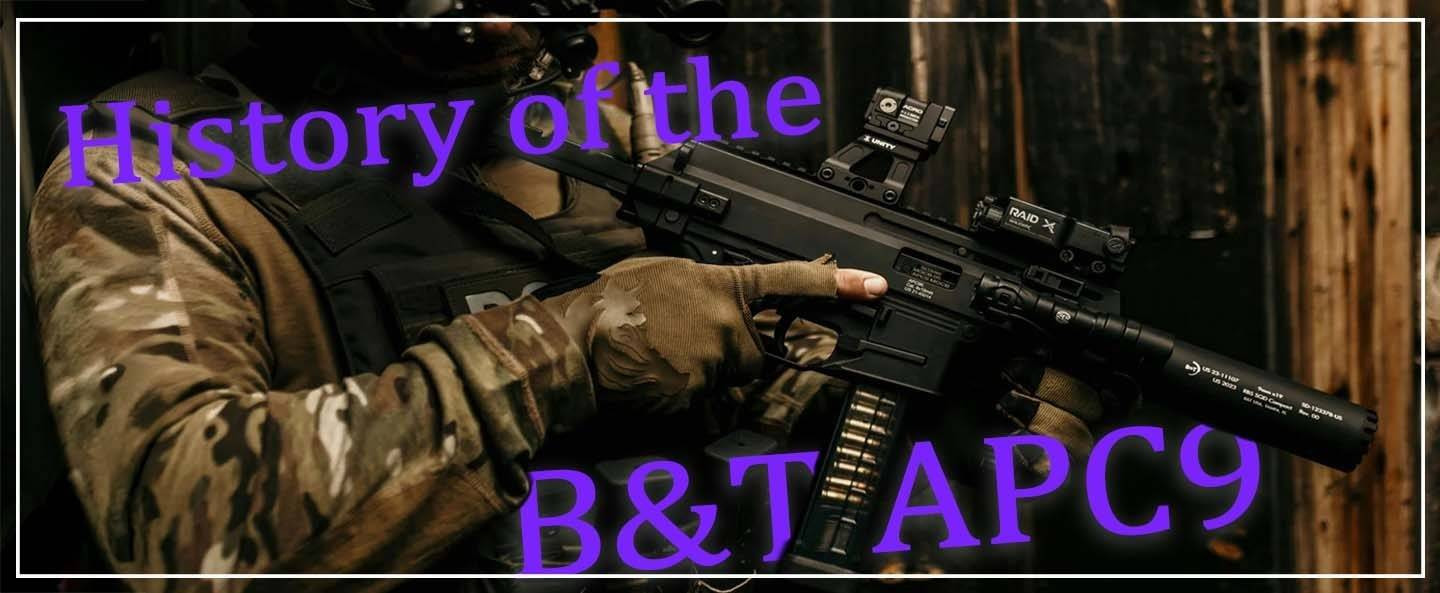
History of the B&T APC

History of the B&T APC

Posted by Miko C. on Jan 30, 2026

The KWA TAC 9, and where it draws it's inspiration

If you’ve been keeping an eye on recent GBB replicas that’ve been released, you might’ve seen that KWA released the TAC-9. A small, sleek, Gas Blowback SMG designed around the B&T APC9, more specifically the APC9 Pro series, which I will get into more later. This builds on KWA’s large arsenal of real-world inspired replicas like the LM4, Kz. 61 Scorpion, F90, and KMP9 (which the TAC 9 can share magazines with). With KWA expanding their replicas into more options for Law Enforcement and Military to use airsoft as a bridge for training let's take a moment to delve into the uses of the TAC-9 and the real world counter part; the B&T APC9

Real World History on the APC9 
Back in 2011, B&T (Brügger & Thomet) started development on what they described as a modern replacement for the aging MP5. At that point, the MP5 was already decades old and struggling to keep up with modern expectations: modularity, suppressor compatibility, optics mounting, and modern ergonomics.
Instead of designing a one-off submachine gun, B&T went bigger. They created what they called the Advanced Police Carbine (APC)—a complete weapon system designed from the ground up. The APC platform wasn’t limited to 9mm either; it was engineered to scale across multiple calibers including 9×19, .40 S&W, 10mm, 5.56, .300 BLK, and even .308. The APC9 was simply the most compact and widely adopted variant.
One of the key design features and talking points wasn't made because of marketing or anything like that, but because of personal need! The APC9 was designed with fully ambidextrous controls because Karl Brugger himself is left-handed! Meaning that ambi controls and ergonomics truly were baked into the gun from day one.
an Early APC9
Early Adoption of the APC
The APC9 didn’t start with flashy U.S. military and law enforcement contracts. Instead, first major users were European police forces and counter-terror units. B&T has also been very supportive with providing one-off models for small contracts. Something that is beautiful with the design of the APC where there is alot of flexability with caliber, magazine cross compatability, and altering the handguard for different environmental restrictions.
Slovakian Police seen with the APC9
  • Austrian EKO Cobra became one of the earliest adopters around 2014, using the APC9 in high-risk law enforcement and counterterrorism roles.

  • Shortly after, Belgium, Lithuania, and Basel-Landschaft followed.

  • In 2016, the Slovakian Police adopted the APC9 as their new service SMG, marking the platform’s second major contract.

Austrian EKO Cobra using the APC9 in a training exercise (2019)
These early adoptions helped prove the system’s reliability and pushed B&T toward refining the design further. With there even being a case of B&T buying back an APC9 from a rental range, and after having ~100,000 rounds through it, the SMG was still functioning and in relatively good condition. A solid testiment on the performance and longevity the relatively simple system is capable of, which also shows off to the units that would be using the SMG that they can trust it. 
The APC9 Pro: Refining, not Reinventing
Around 2018–2019, B&T introduced the APC9 Pro series, which addressed feedback from real-world users. The updates were subtle, but played a large part in improving the longevity of the platform and the continued modernization. 
Some of the updates and improvements were: 
  • Dual charging handles

  • Removal of integrated iron sights in favor of optics

  • Updated handguard featuring M-LOK instead of solely Picatinny rail segments

  • AR-15 style pistol grip compatibility

  • Updated lowers capable of accepting Glock or SIG P320 magazines

The Pro series also refined the gun’s internal mechanics. During prototyping, the APC lacked a way to slow the bolt resulting in a ridiculously high fire rate of ~1,800RPM. This fire rate was “too unmanageable” and “too fast” for the implication of the firearm, so they sought to fix this problem. B&T introduced a hydraulic buffer which slowed the RPM down to 850-1,000RPM (dependent on ammo type used), making the weapon significantly easier to manage in close-quarters environments. A main concern with this buffer would be that it would wear out faster due to it taking substantial force from the bolt, so with the introduction of the pro models, there was an upgrade to the buffer, making the central rod thicker.
The Turning Point of the APC9
Everything changed in 2018, when the U.S. Army launched the Sub-Compact Weapon (SCW) Program. Some of it’s main competitors were the CZ Scorpion, the Beretta PMX, the Zenith Z-5, the SIG MPX, Noveske SCW, and a few others. The Army wanted a weapon that could:
  • Fire 9×19

  • Operate in semi and full auto

  • Be under 15 inches collapsed

  • Weigh less than 7 pounds

  • Maintain lethality at close range with minimal collateral damage

B&T initially offered a variant of the MP9, but it was disqualified due to stock and configuration issues. Instead, they submitted a compact version of the APC9—and it worked.
Originally Proposed MP9
Adopted APC9
In 2019, B&T won the contract, beating out competitors including SIG Sauer’s Copperhead. For people in the firearms and tactical industry there is alot of love and preference towards the SIG series of rifles, theres plenty of examples of special  units using the MCX, Rattler, Copperhead, and the newest adoption of the SIG M7 NGSW.  The deal for the APC was worth $2.5 million for 350 units, with the option to expand to 1,000 additional weapons. This marked the first official U.S. military SMG adoption since the M3 Grease Gun in 1943. (while other SMGs like the MP5, MP7, P90, etc were all limited service adoptions)
The APC9s competitor, the SIG Copperhead
The last officially adopted SMG by the US, the M3 "Grease Gun" 
Military Usage
The main purpose of the APC9s adoption was for special purpose mission sets, like protection details, to be used by Military Police, security personnel, etc. It has been used with limited coverage for base protection in the continental US, as well as Protective Service Detachments (PSDs).
Further Adoption of the APC

After the Army’s decision, adoption accelerated fast:

  • Westchester County, NY (2018): Adopted integrally suppressed APC9-SD variants.

  • U.S. Air Force (2020): Purchased 65 APC9s to replace MP5s used by security personnel.

  • U.S. Customs and Border Protection: Acquired 285 APC9s with SIG-compatible magwells.

  • Miami Beach Police Department (2020): First agency to adopt the P320-compatible APC9K, matching their duty pistols.

  • Hillsborough County Sheriff’s Office (2022): Chose the APC9 to address increasingly complex service calls.

Internationally, adoption continued:

  • Argentina’s FOE (2021): Paired APC9 Pro-G variants with Glock 19X and 17 Gen 5 pistols.

  • São Paulo Military Police (2021): Purchased 1,000 APC40s, replacing flawed Taurus SMT-40 SMGs.

  • São Paulo Civil Police (2023): Added 700 APC9 Pro-G units.

  • Ukraine (2023): APC9s appear with the State Bureau of Investigation, while APC45 variants see combat use.

Ukrainian SBI with the APC9
Sao Paulo Civil Police training with the APC40
So Why Does the APC9 Matter?

The APC9 isn’t popular because it looks cool (beauty is in the eye of the holder). It matters because it represents a shift in how modern agencies think about close-quarters weapons. Instead of adapting old designs, the APC9 was built specifically for modern threats, modern gear, and modern logistics. Magazine compatibility with service pistols, suppressor-ready variants, ambi controls, and scalable production weren’t afterthoughts—they were the point. For a gun that started as a replacement for an aging MP5, the APC9 has ended up becoming something much bigger: a modern standard for compact duty weapons across military and law enforcement worldwide.


And honestly? That kind of design-by-necessity is what makes it interesting.


This is a very focused look on a couple weeks worth of research on the APC9 and continued research on it's competitors. All thanks to my own use of KWA's GBBs, including the TAC 9's older sibling, the KMP9R, which has also sparked the urge to deep dive the MP9 in it's own. I think this replica is a great addition to anyones collection; as a replica of a unit or cosplay, or even just as a new airsoft replica to add to your arsenal. You can checkout the KWA TAC-9 on our website and other media including a review of the KWA TAC-9 on our socials!