
Intro to the LCT VSS:
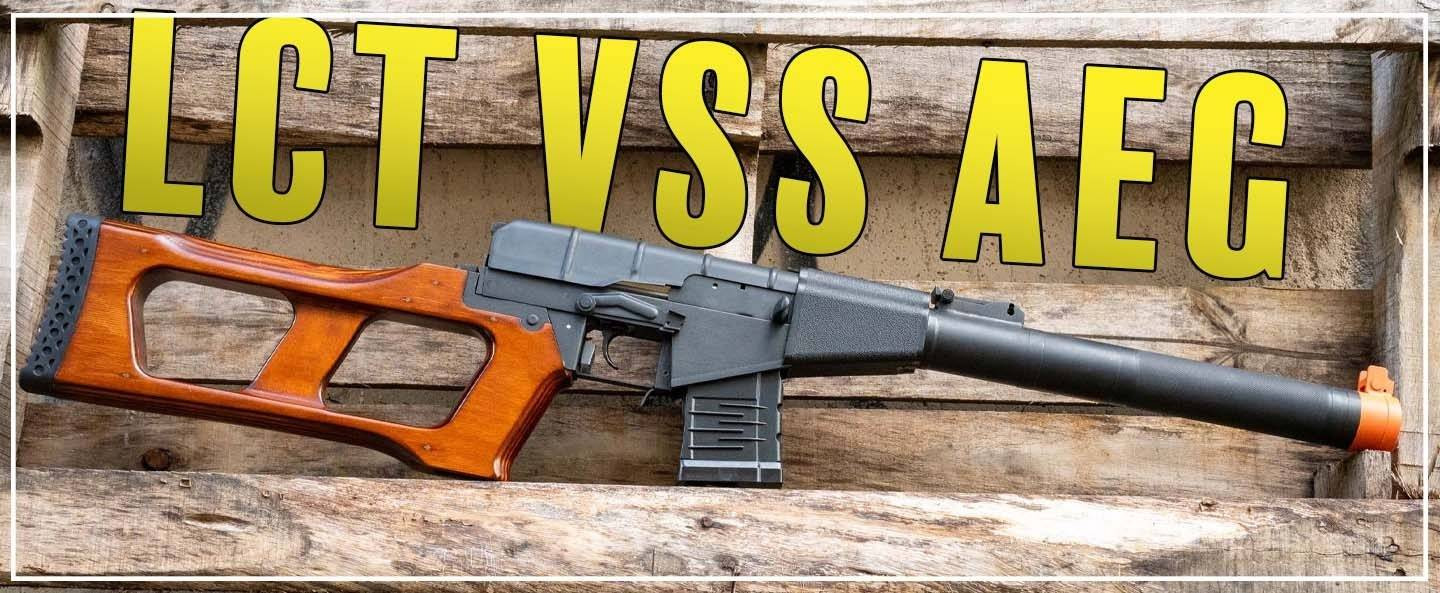
The LCT VSS Vintorez is an airsoft player's dream if you're chasing that Cold War-era Spec-Ops aesthetic. Seen on the battlefield amongst special forces as well as used to devastating effect in the digital space. Built to replicate the iconic suppressed Russian sniper rifle; the VSS Vintorez, this AEG blends realism, ruggedness, and pure style. LCT went all-in on authenticity—featuring a steel receiver, real wood stock, and integrated suppressor that gives it a menacing silhouette straight out of a Spetsnaz mission.
Internally it runs a reinforced Version 3 gearbox, a selectable semi and full-auto fire switch, and with higher end hobby materials it is a solidly built rifle. While battery space is tight (since it fits inside the suppressor), and its options for attachments are lacking, the overall construction makes it a go-to for anyone building a DMR-style loadout or just looking to stand out from a sea of M4s and AKs.

Real World History:
In the late Cold War years, the Soviet Union recognized a growing need for specialized subsonic weaponry. Conventional 7.62x39mm rounds were loud and not ideal for covert or “sneaky boi” operations carried out by Spetsnaz and other clandestine units. The entire practice of suppressing rifles had originated from German forces in World War 2 (most notably seen attached to K98K). Soviet soldiers presumably found these attached to rifles on the battlefield and realized this was something that needed to be explored. Not wanting to be left behind, Soviet firearm designers began working on suppressors for themselves, leading to several prototypes and eventually the PBS-1. The Soviet designers took it a step further, the newer muzzle attachment device utilized special rubber wipes that rounds would fly through as they left the barrel. This was designed to prevent the fast expanding gas and sparks of powder from leaving the barrel.
While very effective in both of those functions it greatly affected the accuracy of the round after puncturing the rubber wipe, and after enough firing the patch would become ineffective, needing to be replaced to hold gas and unburn powder. This was a unique position Soviet forces found themselves in; while the PBS-1 was considered extremely effective in suppressing sound and flash, it left much desired in regards to accuracy and prolonged firing. To fill this gap, Soviet engineers began experimenting with dedicated suppressed rifles.
In 1981, the prototype RG-036, chambered in subsonic 7.62x39mm, was put forward. However, the GRU General Staff soon demanded a round specifically optimized for suppressed shooting. This led to the development of the 9x39mm cartridge, a heavy subsonic round traveling around 300 meters per second. With the new cartridge came a new weapon: the VSS Vintorez (VSS = Vintovka Snayperskaya Spetsialnaya or “Special Sniper Rifle”. Vintorez = “Thread Cutter”), finalized in 1983.
The Research Institute that designed the VSS, and later the AS Val, also made the initial specialized ammunition for their special firearm. The TsNIITichMash designed the SP-5 and SP-6, with some sources claiming the SP-5 was built for VSS Vintorez and the SP-6 was built for the later produced AS Val. However in some extended research there is not enough to support those reports. What deeper research has revealed was the SP-5 is designed as a conventional round, Lead cored FMJ that happened to have better accuracy at further distances (300-400 meters) than the SP-6. The SP-6 was designed to be an armor-piercing hardened-metal variant stated to penetrate 30 layers of Kevlar at 200 meters. So it makes sense the more accurate round goes to the ‘Sniper’ and the armor-piercing round goes to the ‘Assaulter’ rifle. As a note, the PASGT vest the US Army was wearing at the time is noted as having 13-19 layers of Kevlar around the time the VSS and AS were fielded. A little fact for some perspective of what was happening back then.


Over the decades, the VSS, AS VAL, later VSSM (modernized), and other firearms based upon the VSS have appeared in real conflicts, including Afghanistan, Syria, Iraq, and the Russo-Ukrainian wars. Today, these rifles remain staples of counter-terrorism units and clandestine operations, prized for their integrated suppressor systems that drastically reduce firing noise while maintaining lethal performance.
About LCT:
What makes LCT stand out is their build quality. Their guns feel solid and look super close to the real thing. While their internal parts are solid out of the box, a lot of players love using LCT as a base for upgrades because the externals are so well made.
Recently, they’ve been moving into ETU (Electronic Trigger Unit) tech to modernize their lineup, but they still stick to their classic styling and durability. Everything they make is designed and built in-house, which means you’re getting original products, not just rebranded parts.
If you want something that looks and feels real—and lasts—LCT is a great choice.
Stay tuned for some more LCT content in the near future, were working on some more unique builds using LCT rifles as the base!

Tip to Butt:

The entire mock suppressor is steel, same with alot of the body and pins on the body. Is VERY DIFFICULT to remove. There is a small button to press to get the suppressor to twist 90 degrees. Wiggle it as much as you can to pull it straight off. There are 2 pins to ‘guide’ and lock the barrel shroud to the receiver that are inside the mock suppressor. You do need your entire weight and more wiggling to get the barrel back on and twist it into place. For anyone small or lacking gains you WILL need help.
Under the mock suppressor is a simple wiring harness that is small tamiya, the inner barrel runs the entire length of the suppressor shroud. The battery needs to be thin and ideally be panelled, for this portion we used an 11.1V G&G tri-panel battery for testing. Originally we grabbed a 7.4V Li-Ion battery and tested without the mock suppressor but there was not enough room and pushed the inner barrel out of alignment when trying to attach the outer barrel.
The only issue is that when taking the battery out you will need to be careful, the 2 stems on the inside of the mock suppressor will catch on batteries and prevent you from removing them nicely. There is also a cool feature on the LCT where the internal aluminum piece that has helical drill marks represents what the barrel would look like on the real version.
The rear iron sight ladder on the LCT replica appears to mirror the iron sights, the numbers referring to the meters value the real rifle would be using for distance shooting. 10=100 meters, 27=270 meters, etc. Even in the real world, the VSS is noted for being most effective up to 400 meters. Maybe because the iron sights only go to 400?


Going backwards the handguard is polymer and there are not any good options after market for changing that out. The options for additional rails are going to be adding clamps to the mock suppressor, which is something that is done within the real world. That is going to be the best option for adding grips, flashlights, lasers, etc. On the left hand side of the rifle is a small exposed loop that is for mounting slings, I see alot of Russian soldiers use their metal clips directly on the loop but I prefer saving my rifles from as many scratches as possible. Using either a simple paracord loop or using the Uloop Sling Mount from Blue Force Gear to attach preferred sling to your rifle.
The actual body of the receiver is VERY well built, made of real steel and is very robust. The magazine release spring is very tight and can catch the material of a glove if you run it close to the receiver. On the right hand side; the charging handle is also steel, but is going to wear down the finish very quickly. It also has a very short length of travel, but it also needs to just pull backwards far enough to adjust the hopup unit. The safety switch has gotten very loose, in the short time that I have been messing with it while writing this blog. On the left hand side you do have a long side railing for SVD style of optic mounts.


I will say that my favorite thing about researching the VSS is the specific applications the VSS was designed around and how it get utilized. One of my favorite things is triggering other staff members when I begin explaining the versatility and application of the VSS and AS VAL, and how a player could play with it. For example; the VSS is a sniper, its literally in the name. But it has a selector switch so its also a DMR. But if you use a folding stock like the AS VAL its an assault rifle. And from the same gun desinger, if you change the handguard out and use the folding stock then you have the SR3 Vihkr "Whirlwind". We were also really close to having a potential Squad Support Weapon VSS. There was a type of LMG box magazine (PKM style) that would take belt contained rounds and feed them into an RPK and the action of the charging handle would move a crink that would pull the belted round into the chamber. I dont know how developed that magazine was but I almost couldve made an argument that the VSS couldve been used for every airsoft role!
The LCT VSS Vintorez isn’t a rifle you buy because it’s convenient, lightweight, or endlessly modular. You buy it because it represents a very specific philosophy of weapon design—one rooted in patience, concealment, and purpose. Just like the real VSS, this airsoft replica asks the user to work with its limitations rather than fight them. Tight battery space, limited accessory options, and a few ergonomic quirks are simply part of the package.
What you get in return is one of the most authentic-feeling Soviet platforms available in airsoft. The weight, materials, and construction give it a presence that’s hard to replicate with modern polymer rifles. Scratches will appear, finish will wear, parts will loosen slightly over time—and honestly, that only adds to the character. This is a rifle that looks better the more it’s handled.
For players building Cold War or modern Russian kits, running DMR-style roles, or simply wanting something that stands apart from the usual AR and AK patterns, the LCT VSS delivers an experience that feels intentional and grounded in history. It’s not a meta rifle. It’s not a speedsoft rifle. It’s a vibe rifle—and a damn good one at that.
If you’re willing to accept its quirks and embrace its design philosophy, the LCT VSS Vintorez isn’t just another airsoft gun—it’s a statement piece.

